ドローンの着陸位置ズレを解消する「自動センタリング着陸機構」を開発
ドローンの自動運行の安定性向上やワイヤレス給電装置の小型化・低コスト化に寄与
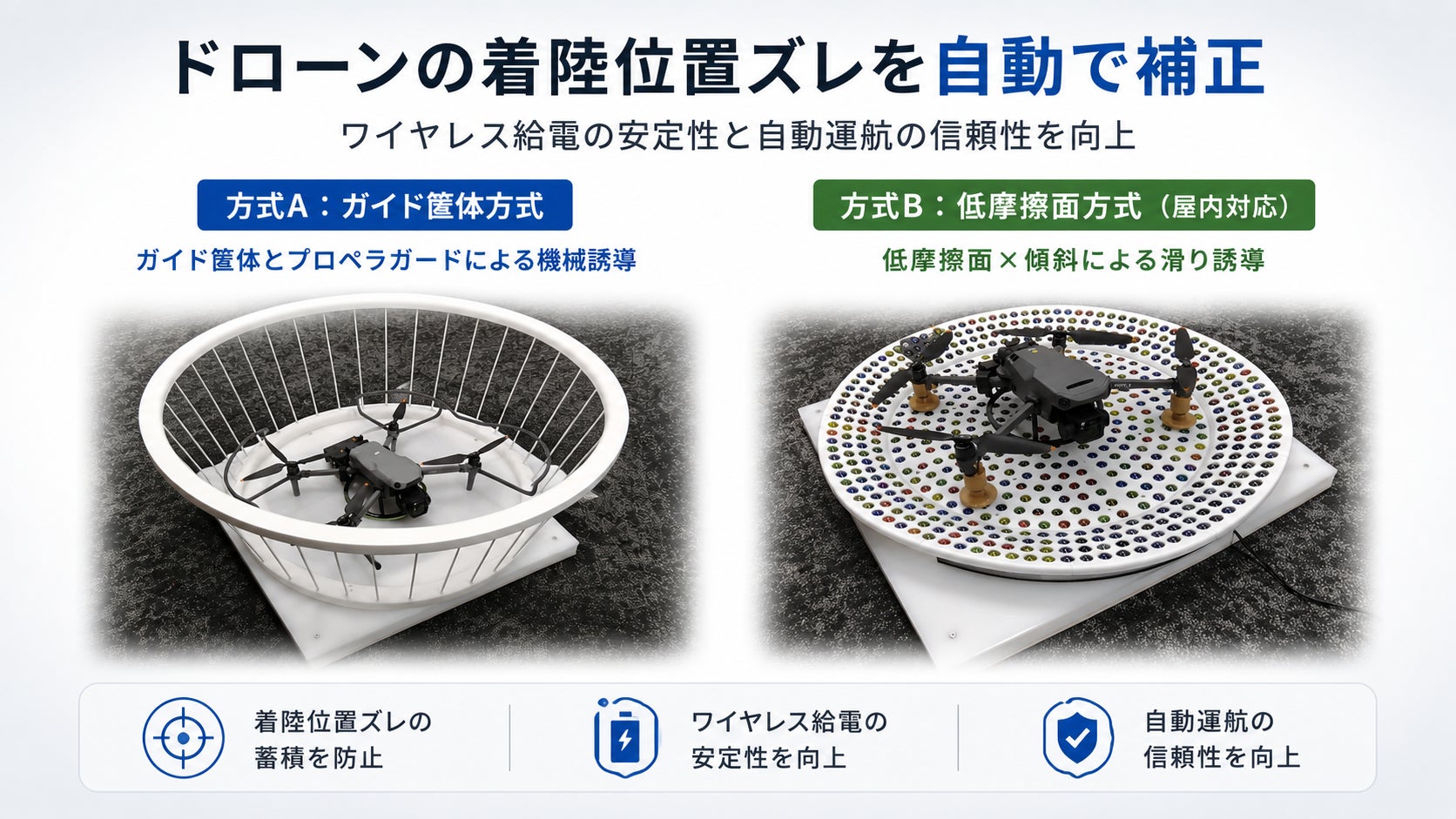
株式会社ビー・アンド・プラス(本社:埼玉県比企郡小川町、代表取締役:亀田篤志)は、ドローンが着陸する際に発生する位置ズレを自動的に補正し、常に中央位置へ着陸させる 「ドローン自動センタリング着陸機構」 を開発しました。
本技術は、ガイド筐体を用いた機械誘導方式と、低摩擦面+傾斜を利用した滑り誘導方式の 2種類の中央寄せ機構で構成されており、ドローンの自動運行の安定性向上や、ワイヤレス給電装置の小型化・低コスト化に寄与します。
1. 背景:ドローン自動運行における「着陸位置ズレ問題」
ドローンは自動運行を繰り返すと、着陸位置のわずかなズレが蓄積し、本来の離陸ポイントから徐々に外れていくという課題があります。
通常は操縦者が手動で位置合わせを行うため問題になりませんが、 人手を介さない自動運行では、このズレが大きな障害となります。
さらに、ワイヤレス給電を行う場合、着陸位置ズレを考慮して送電側コイルを大型化すると、 装置が高コスト化し、設計も複雑になります。
2. 本技術の概要:2種類の中央寄せ機構を開発
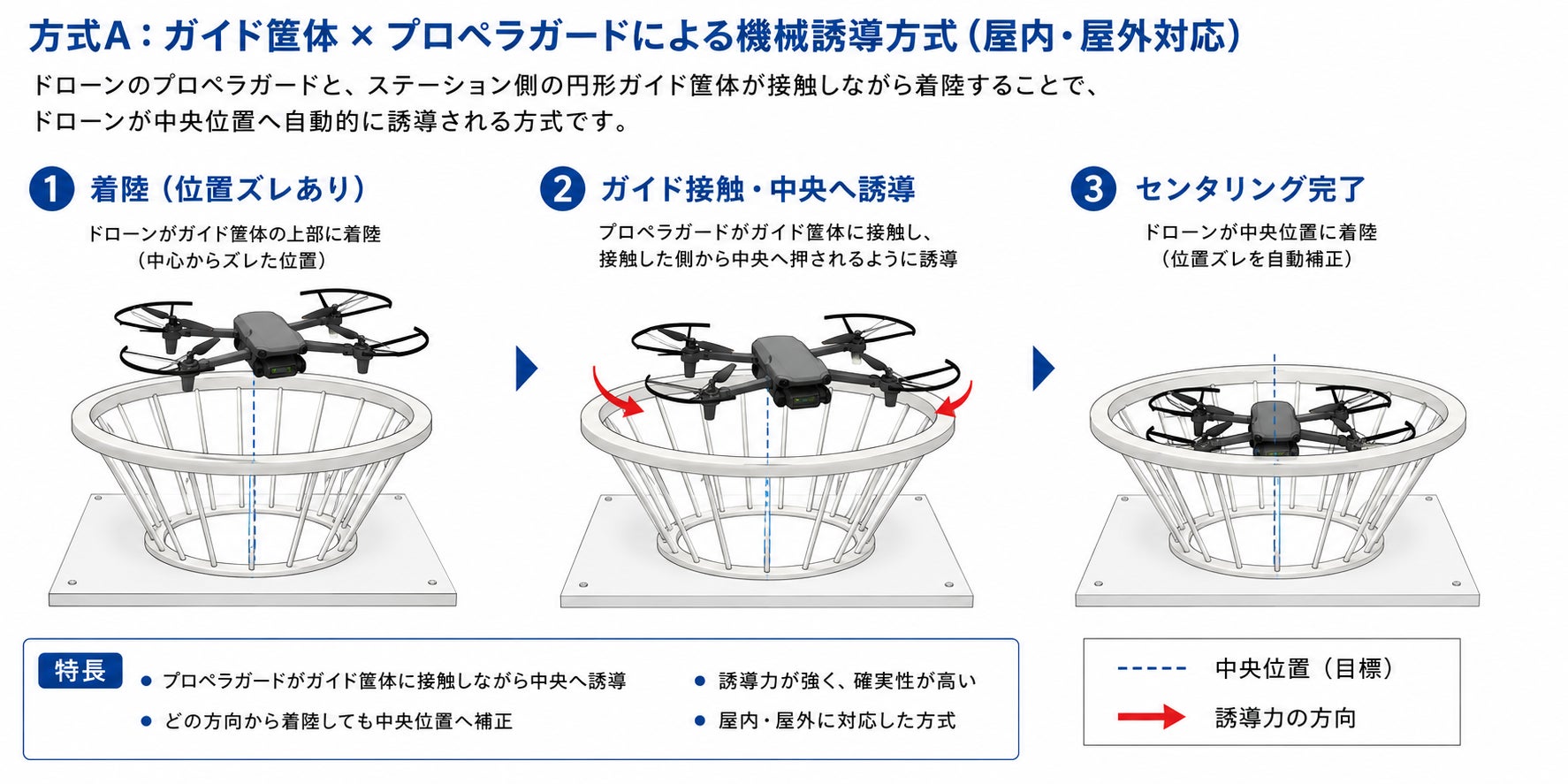
方式A:ガイド筐体 × プロペラガードによる機械誘導方式
ドローンのプロペラガードと、ステーション側の円形ガイド筐体が接触しながら着陸することで、 ドローンが中央位置へ自動的に誘導される方式です。
・プロペラガードがガイド筐体に触れながら中央へ誘導
・どの方向から着陸しても中央位置へ補正
・ドローンにプロペラガードを装着
・誘導力が強く、確実性が高い
・屋外・屋内に対応した方式
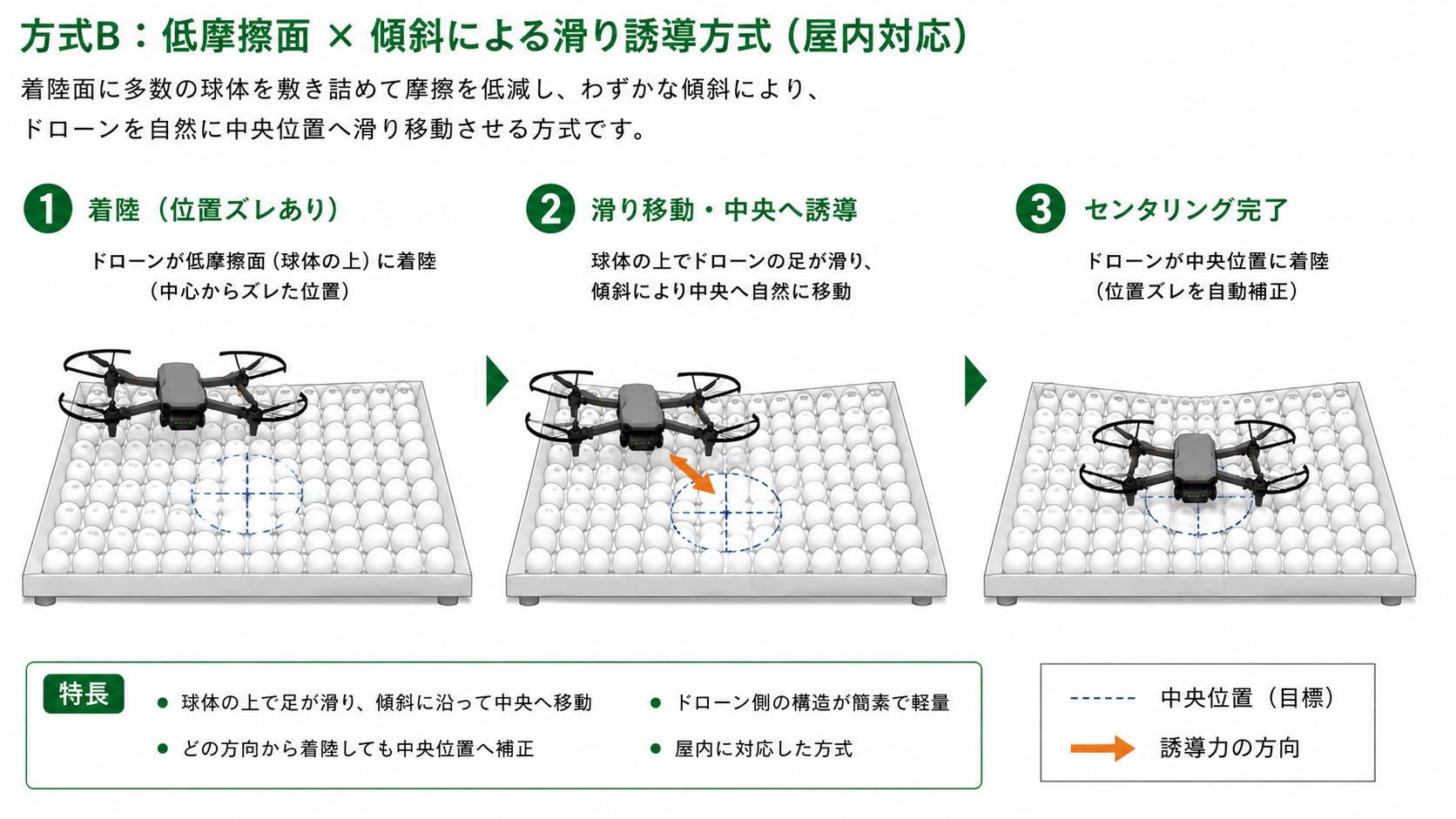
方式B:低摩擦面 × 傾斜による滑り誘導方式
着陸面に多数の球体を敷き詰めることで摩擦を極限まで低減し、 わずかな傾斜によりドローンが自然に中央へ滑り落ちる方式です。
・球体の上でドローンの足が滑り、傾斜に沿って中央へ移動
・どの方向から着陸しても中央位置へ補正
・ドローンの足にアタッチメント装着
・ドローン側の構造が簡素で軽量
・屋内に対応した方式
3. 本技術が実現するメリット
・着陸位置ズレの蓄積を防止
・自動運行の信頼性向上
・ワイヤレス給電装置の小型化・低コスト化
4. 動画
自動センタリング着陸機構の動画
5. 今後の展開
自動センタリング着陸機構のさらなる改良を進めるとともに、 ワイヤレス給電ステーションとの組み合わせによる実証実験を進めます。
また、本技術に興味を持つ企業・団体に対しては、試作品の提供や共同検討にも対応していく予定です。
6. 新着情報
【New】ドローン向け12Sバッテリー対応・500Wワイヤレス充電システム
https://www.b-plus-kk.jp/blog/2026/05/01/886
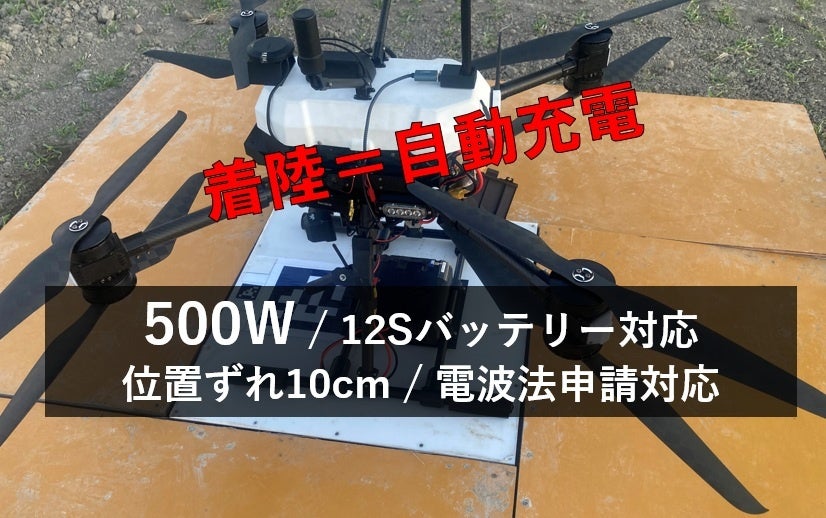
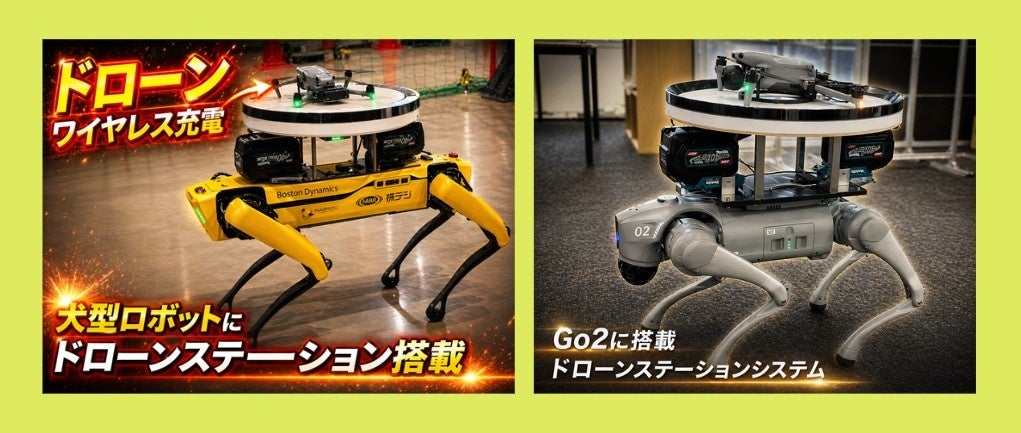
【New】移動型ワイヤレスドローンステーションを簡単に構築できるシステムの提供開始!
https://www.b-plus-kk.jp/blog/2026/05/08/894
7. 会社概要
会社名:株式会社ビー・アンド・プラス
所在地:埼玉県比企郡小川町
事業内容:ワイヤレス給電技術、産業用センサ、FA機器開発
ホームページ:https://www.b-plus-kk.jp
ドローン情報:https://www.b-plus-kk.jp/product/Drone.html
お問い合わせ:https://www.b-plus-kk.jp/contact
Development of an "Automatic Centering Landing Mechanism" to Eliminate Drone Landing Misalignment
B & Plus Co., Ltd. (Headquarters: Ogawa-machi, Hiki-gun, Saitama Prefecture; Representative Director: Atsushi Kameda) has developed a "Drone Automatic Centering Landing Mechanism." This system automatically corrects positional misalignment during landing, ensuring the drone consistently lands in the center. The technology comprises two types of centering mechanisms: a mechanical guidance method using a guide housing, and a sliding guidance method utilizing a low-friction surface and an incline. It contributes to improved stability in autonomous drone operations and enables the miniaturization and cost reduction of wireless power supply systems.
Background: The "Landing Misalignment Issue" in Autonomous Drone Operations With repeated autonomous flights, drones face the challenge of accumulating slight landing position errors, causing them to gradually drift away from their original takeoff point. While this is typically not an issue because operators manually align the drone, such misalignment becomes a significant obstacle in fully autonomous operations that do not involve human intervention. Furthermore, when using wireless power supply systems, enlarging the transmitter coil to accommodate potential landing misalignment leads to higher equipment costs and increased design complexity.
Overview of the New Technology: Development of Two Centering Mechanisms
Method A: Mechanical Guidance Method Using Guide Housing and Propeller Guards
In this method, the drone is automatically guided to the center position as it lands, with the drone's propeller guards making contact with a circular guide housing on the landing station.・Propeller guards contact the guide housing to steer the drone toward the center
・Corrects the position to the center regardless of the landing direction
・Requires propeller guards to be attached to the drone
・Strong guiding force and high reliability
・Suitable for both indoor and outdoor use
Method B: Low-friction surface + Sloped sliding guidance
This method minimizes friction by covering the landing surface with numerous spheres, allowing the drone to naturally slide toward the center due to a slight slope.
・Drone landing gear slides over the spheres, moving toward the center along the slope
・Corrects the position to the center regardless of the landing direction
・Requires attachments on the drone's landing gear
・Simple, lightweight structure on the drone side
・Suitable for indoor use
Technical Advantages
・Prevents the accumulation of landing position errors
・Improves the reliability of autonomous operations
・Enables smaller, lower-cost wireless power transfer units
Future Outlook
We will continue to refine the automatic centering landing mechanism and conduct demonstration tests in combination with wireless power transfer stations.
We also plan to provide prototypes and engage in joint evaluations with companies and organizations interested in this technology.
[New] 500W Wireless Charging System for Drones (Compatible with 12S Batteries)
https://www.b-plus-kk.jp/blog/2026/05/01/886
[New] Launching a system for easily building mobile wireless drone stations! https://www.b-plus-kk.jp/blog/2026/05/08/894
https://www.b-plus-kk.jp/blog/2026/05/08/894
Company Overview
Company Name: B & Plus K.K.
Location: Ogawa Town, Hiki District, Saitama Prefecture
Business Activities: Development of wireless power transfer technology, industrial sensors, and factory automation (FA) equipment
Website: https://www.b-plus-kk.jp
Drone Information: https://www.b-plus-kk.jp/product/Drone.html
Contact: https://www.b-plus-kk.jp/contact
このプレスリリースには、メディア関係者向けの情報があります
メディアユーザー登録を行うと、企業担当者の連絡先や、イベント・記者会見の情報など様々な特記情報を閲覧できます。※内容はプレスリリースにより異なります。
すべての画像
