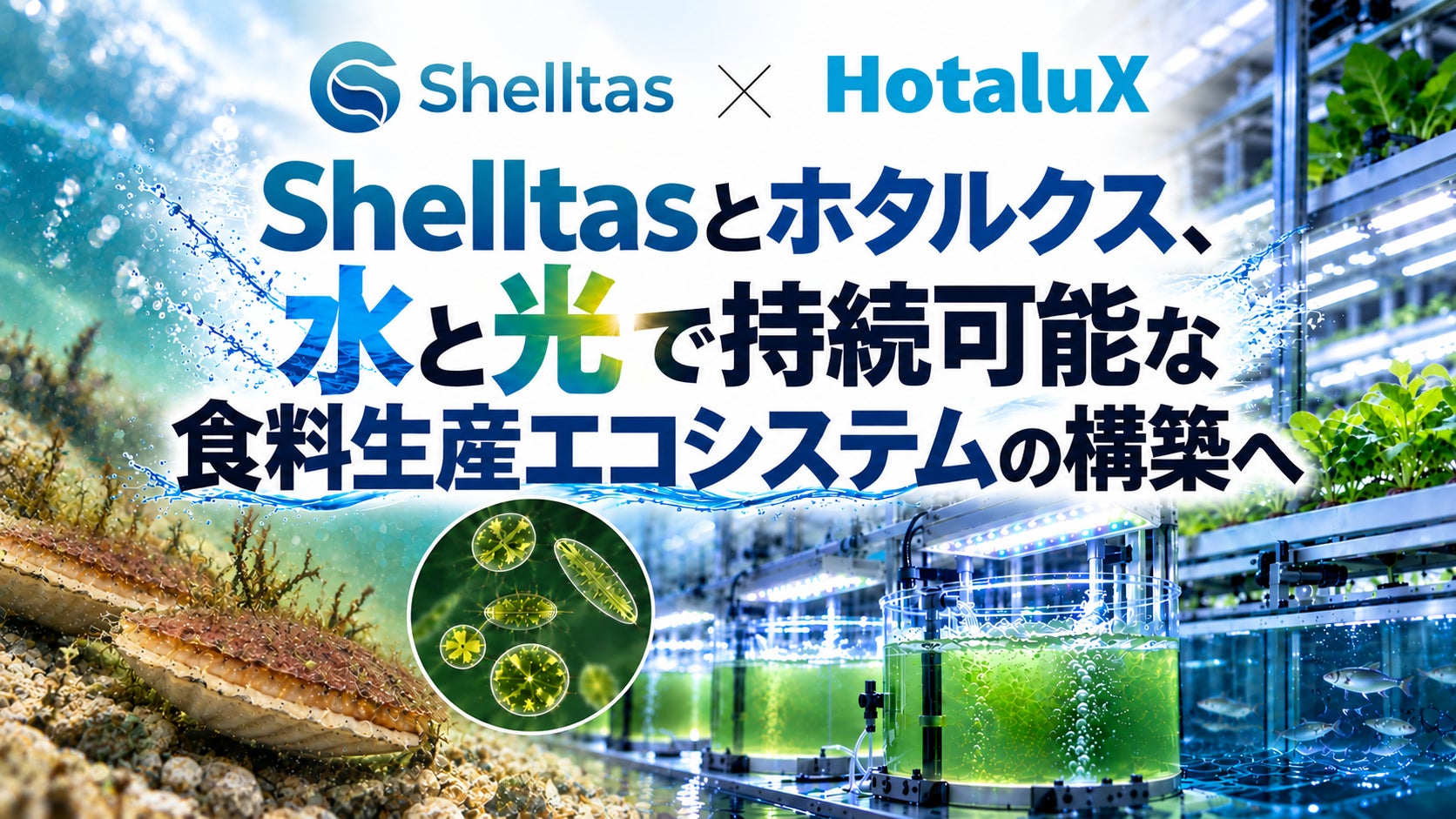
Shelltasとホタルクス、水と光で持続可能な食料生産エコシステムの構築へ
Water OSによる完全閉鎖・無換水のホタテ飼育を基盤に、プランクトン培養・アクアポニクス用照明の共同開発を見据えた実証実験を開始
株式会社Shelltas(本社:東京都大田区、代表取締役:徳田浩一、以下「Shelltas」)と株式会社ホタルクス(以下「ホタルクス」)は、プランクトン培養用照明とアクアポニクス用照明の二つを軸に、共同開発を見据えた実証実験に取り組んでいます。
すでに東京都大田区にあるShelltasのラボで実証実験を開始しています。ShelltasがSeaFect®を基盤に開発した「Water OS」による水環境の維持と、ホタルクスの光技術を組み合わせ、水・餌・植物の生育を支える持続可能な食料生産エコシステムの構築と、用途別照明の商用化を目指します。
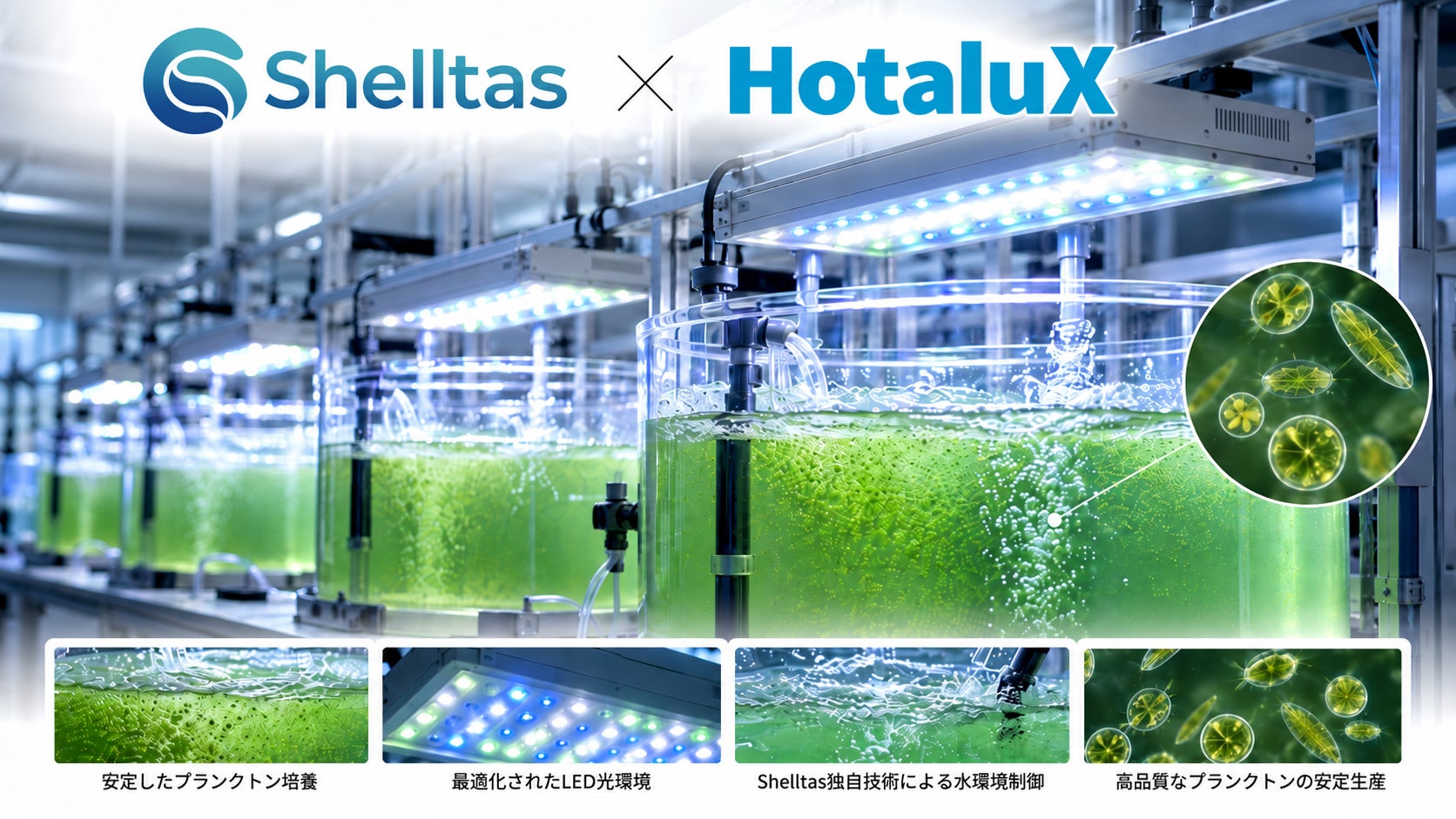
ホタテなどの貝類を育てる、プランクトン培養用照明
Shelltasは、ホタテ貝殻由来の海洋性カルシウム素材「SeaFect®」を基盤に、水環境を設計・維持する独自技術「Water OS」を開発しています。この技術を用いた完全閉鎖型の飼育環境で、ホタテを6か月間、無換水で飼育し続けています。海から継続的に飼育水を取り込む方式ではなく、蒸発分の水を補給しながら、飼育水を交換せずに維持する取り組みです。
ホタテの陸上での長期飼育・生産を難しくする課題の一つが、餌となる植物プランクトンを必要な量と品質で継続供給することです。海では自然の餌料環境を利用できますが、閉鎖された陸上の飼育環境では、その供給を自ら支える必要があります。Shelltasの飼育現場でもホタテがプランクトンを速いペースで消費しており、水環境と餌の両方を維持できる仕組みが求められています。
そこでShelltasは、植物プランクトンの自社培養を構想しています。一度培養して終わるのではなく、貝類の摂餌に応じて培養・供給し続けることが、持続的な生産の重要な条件です。ホタルクスとともに培養に適した照明条件を検証し、餌の継続生産を支える照明の開発につなげます。将来的には、プランクトンを餌とする他の貝類への応用も検討します。
陸上での食料生産を支える、アクアポニクス用照明
もう一つの開発テーマは、魚介類の飼育と植物栽培を組み合わせるアクアポニクス向けの照明です。
屋内で植物を育てるには、太陽光の代わりとなる光を確保する必要があります。しかし、太陽光の幅広い特性を人工照明で再現することは容易ではありません。植物の生育に必要な光を十分に届けることと、照明にかかる電力消費を抑えることの両立が、商用化に向けた重要な開発課題となります。
Shelltasは、大田区のラボで実際のアクアポニクス環境を用いた実証実験を開始しています。ホタルクスとともに、植物の生育を支える光の強さや照射条件を検証し、生育性能とエネルギー効率の両面から、商業運用に適した照明の開発を目指します。
水揚げの減少に加え、次世代を育む親貝も激減
青森県陸奥湾では、高水温などの影響により、現在の出荷と将来の再生産の両方が深刻な課題に直面しています。2025年度のホタテ共販数量は前年度比34%減の19,766トン。さらに、青森県漁連の集計を伝えた2026年10月2日の報道によると、2026年度上半期(4~9月)の水揚げ量は7,673トンと、前年度の4割未満に落ち込んでいます。
加えて、2026年8月27日配信のみなと新聞によると、卵を産む親貝(2023~2024年産貝)の保有枚数は前年比90.8%減の677万枚に減少しました。県の総合戦略が安定生産に必要とする1億4,000万枚に対し、約5%の水準です。親貝の不足は次世代の稚貝の確保に関わり、今後の生産回復にも影響するおそれがあります。同報道は、春の採苗不振と翌年以降の再生産への影響も指摘しています。現在の出荷量を補うだけでなく、次の世代を育て続けられる生産基盤を確保することが急務です。
Shelltasは、この課題に対応するため、SeaFect®を基盤に開発したWater OSによる完全閉鎖・無換水の飼育と、プランクトンの継続培養を組み合わせる技術を検証しています。ホタルクスとの照明開発を通じ、水環境と餌の供給を管理できる生産の選択肢を育て、将来の安定生産に貢献することを目指します。今後、親貝の維持や次世代の生産にどう貢献できるかについても検証が必要です。
ラボでの実証から、商業運用できる仕組みへ
目指すのは、水を維持し、餌を育て、魚介類と植物を育む機能をつなぐ「食料生産エコシステム」です。Water OSによる飼育水の維持、プランクトンの継続培養、アクアポニクスでの植物生産を、それぞれの実証を通じて統合していく構想です。
ホタテ貝殻から生まれた素材技術を、再び貝類を育てる環境づくりへ。Shelltasとホタルクスは、水と光の技術を組み合わせ、海洋環境の変化に対応できる生産の選択肢を広げます。ラボで得られた結果を照明の仕様や運用条件に反映し、培養・生育性能とエネルギー効率を検証しながら、商業ベースで利用できる製品・仕組みへつなげていきます。
株式会社Shelltasについて
ホタテ貝殻由来の海洋性カルシウム素材「SeaFect®」を開発し、水産・農業などの分野で活用に取り組む素材技術企業です。SeaFect®を基盤に開発した独自技術「Water OS」による、完全閉鎖・無換水での飼育やアクアポニクスの実証を進めています。
代表者:代表取締役 徳田浩一
所在地:〒143-0024 東京都大田区中央1-16-8 シャンボール大森1F
公式サイト:https://shelltas.com/
株式会社ホタルクスについて
NECの照明事業を継承し、2019年に株式会社ホタルクスとして事業を開始した照明メーカーです。住宅・施設向け照明に加え、光を活用した環境衛生や農業分野の製品開発にも取り組んでいます。その技術の歩みには、植物育成用蛍光ランプの開発や、南極・昭和基地での野菜栽培向け光源の供給があり、現在も病害虫防除や植物育成などの光技術を展開しています。
所在地:〒105-0014 東京都港区芝一丁目11番11号 住友不動産芝ビル
公式サイト:https://www.hotalux.com/
本件に関するお問い合わせ先
株式会社Shelltas
担当:森川
E-mail:morikawa@shelltas.com
出典:青森県漁連「ほたての漁業」/みなと新聞 2026年8月27日配信(共販数量・親貝)
https://marinemanager.njc.co.jp/magazine/magazine-20260827-1/
青森朝日放送 2026年10月2日報道(水揚げ量)
https://www.aba-net.com/news/news-200582.html
Shelltas and Hotalux Begin Trials Toward a Sustainable Food Production Ecosystem Built on Water and Light
Based on fully closed, no-water-exchange scallop rearing with Water OS®, with joint development of lighting for plankton culture and aquaponics in view -
Shelltas Inc. (Ota-ku, Tokyo; Representative Director: Hirokazu Tokuda; “Shelltas”) and Hotalux, Ltd. (“Hotalux”) are conducting trials toward joint development of lighting for plankton culture and for aquaponics at Shelltas’s laboratory in Ota-ku. By combining the water environment maintained by Water OS®, developed by Shelltas on the basis of SeaFect®, with Hotalux’s lighting technology, the companies aim to build a sustainable food production ecosystem supporting water, feed and plant growth, and to commercialize lighting for each use.
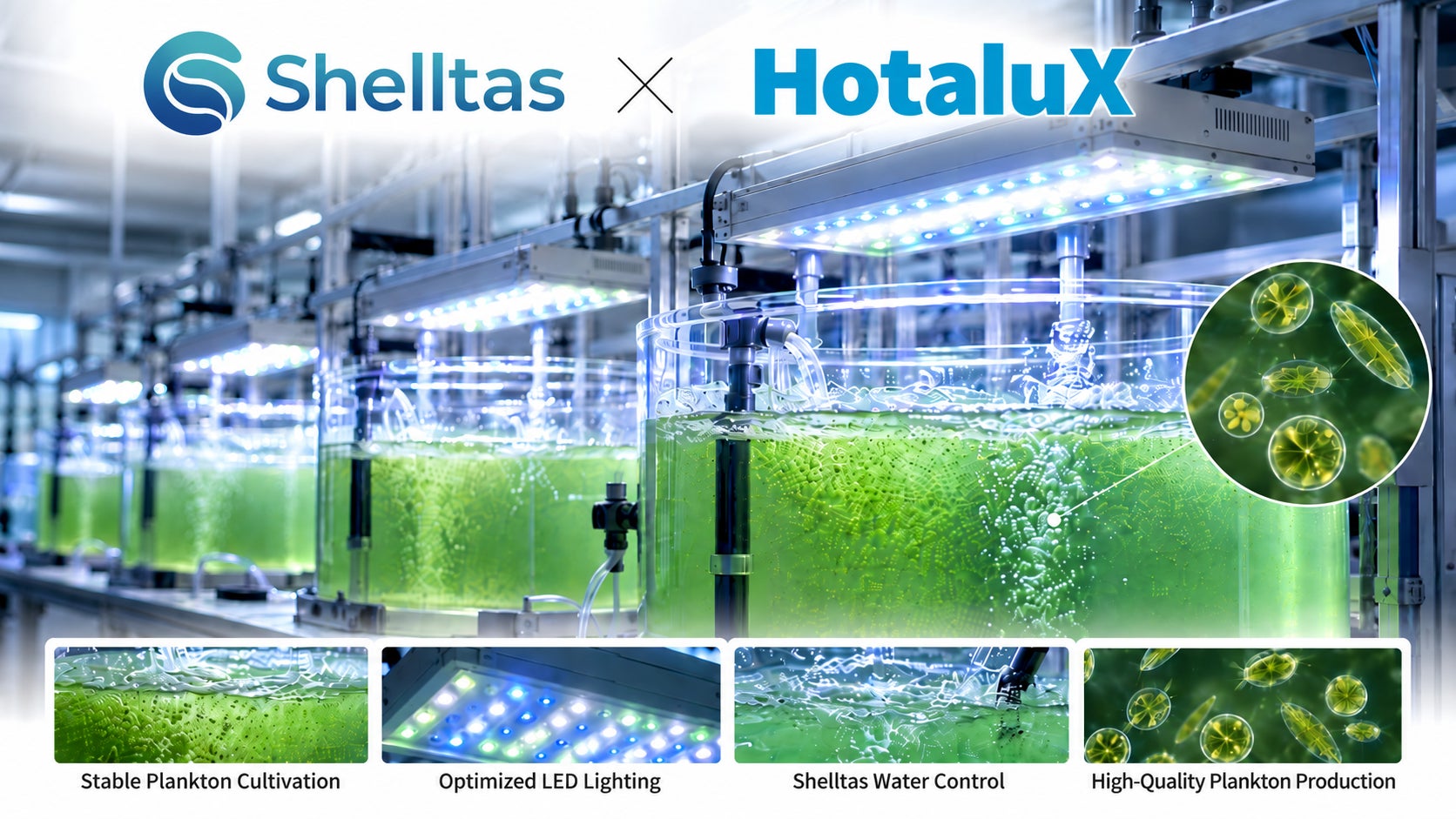
Lighting for plankton culture to raise shellfish such as scallops
Shelltas developed Water OS®, a proprietary technology that designs and maintains the water environment, based on SeaFect®, a marine calcium material derived from scallop shells. In a fully closed environment using it, scallops have been kept for six months without water exchange: evaporated water is replenished, but the rearing water is not replaced or drawn from the sea.
A key challenge for long-term land-based scallop rearing is supplying phytoplankton, their feed, continuously in the required quantity and quality. Shelltas’s scallops consume plankton quickly, so both water and feed must be maintained. Shelltas therefore plans in-house phytoplankton culture, continuously cultured and supplied in line with the shellfish’s feeding. With Hotalux, it will verify lighting conditions suited to culture and develop lighting that supports continuous feed production.
Lighting for aquaponics to support land-based food production
The other theme is lighting for aquaponics, which combines fish and shellfish rearing with plant cultivation. Indoor cultivation needs light that substitutes for sunlight, which is hard to reproduce; delivering enough light while limiting power use is a key challenge for commercialization. Trials have begun in an actual aquaponics environment at the laboratory. With Hotalux, Shelltas will verify light intensity and irradiation conditions, aiming to develop lighting suited to commercial operation in both growth performance and energy efficiency.
Falling catches, and a sharp decline in the parent scallops that nurture the next generation
In Mutsu Bay, Aomori Prefecture, high water temperatures and other factors threaten both current shipments and future reproduction. The fiscal 2025 joint-sale volume of scallops was 19,766 tons, down 34% year on year. An October 2, 2026 report citing the prefectural fisheries federation said the first-half (April-September) catch for fiscal 2026 was 7,673 tons, less than 40% of the previous year.
According to Minato Shimbun (August 27, 2026), spawning parent scallops (2023-2024 cohorts) fell 90.8% year on year to 6.77 million, about 5% of the 140 million the prefecture’s strategy considers necessary for stable production. This may affect juvenile supply and recovery of production. A base is needed that can both make up for current shipments and keep raising the next generation.
To address this, Shelltas is verifying a technology combining fully closed, no-water-exchange rearing with Water OS® and continuous plankton culture. Through lighting development with Hotalux, the companies aim to cultivate a production option in which water and feed can be managed. Its contribution to maintaining parent scallops and the next generation remains to be verified.
From laboratory trials to a system that can operate commercially
The goal is a “food production ecosystem” connecting water maintenance, feed growing, and the raising of seafood and plants, integrating Water OS®, continuous plankton culture and aquaponics through trials of each.
A technology born from scallop shells will be used once again to create environments that raise shellfish. Laboratory results will be reflected in lighting specifications and operating conditions, leading to commercially usable products and systems.
About Shelltas Co., Ltd.
A materials technology company that develops SeaFect® for use in fisheries, agriculture and other fields, and is advancing trials of fully closed rearing and aquaponics with Water OS®.
Representative: Hirokazu Tokuda, Representative Director
Address: Chambord Omori 1F, 1-16-8 Chuo, Ota-ku, Tokyo 143-0024, Japan
Website: https://shelltas.com/
About Hotalux, Ltd.
A lighting manufacturer that took over NEC’s lighting business and began operations as Hotalux, Ltd. in 2019. Besides lighting for homes and facilities, it develops light-based products for hygiene and agriculture, including light sources for vegetable cultivation at Showa Station in Antarctica.
Website: https://www.hotalux.com/
Contact
Shelltas Co., Ltd.
Person in charge: Morikawa
E-mail: morikawa@shelltas.com
このプレスリリースには、メディア関係者向けの情報があります
メディアユーザー登録を行うと、企業担当者の連絡先や、イベント・記者会見の情報など様々な特記情報を閲覧できます。※内容はプレスリリースにより異なります。
すべての画像